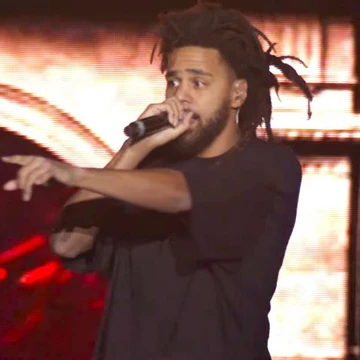
André 3000
The psychedelic sage who turned Southern hip-hop into a kaleidoscope of funk, soul, and raw truth.

André 3000 isn't just a legend—he's the north star of hip-hop's creative fringe, a shape-shifter whose influence bends the genre itself. For J. Cole, he's the mentor he never met, the ghost in the booth who whispers: go deeper, be weirder, stay true. More than a musician, André is the yardstick for authenticity and lyrical soul-searching, the standard Cole chases with every bar.
- Role
- Influential rapper and cultural icon
- Affiliation
- OutKast (with Big Boi), solo artist
- First appears
- In J. Cole's mentions and tributes, such as in the song 'Can't Get Enough' or interviews
- Status
- Active as a musician and actor, though less frequent in releases
Lore & Background
Born André Benjamin in Atlanta, he didn't just emerge from the late-'90s hip-hop scene—he detonated it. As half of OutKast, he and Big Boi fused funk, soul, and sprawling storytelling into something alien and undeniable, shattering every mold of what Southern rap could be. His alter ego, André 3000, became a walking manifesto: electric blue suits, feather boas, and lyrics that veered from existential dread to cosmic joy. He didn't just blend genres—he made them beg for mercy. For J. Cole, André is the ghostlight. Albums like 'Aquemini' and 'Stankonia' weren't just records; they were blueprints for how to be both a poet and a rebel. Cole has said André taught him that substance could outshine trends—that a verse could be a sermon, a confession, or a party, all at once. André's legacy is a restless evolution: from OutKast's early grit to the orchestral heartbreak of 'The Love Below,' from acting in 'Four Brothers' to disappearing into his own art. He's a cipher, a style icon, and a reminder that the weirdest path is often the truest.
In Their Own Story
The studio lights were off. J. Cole sat cross-legged on the floor, headphones clamped over his ears, 'The Love Below' bleeding through the silence. André's voice—half-sung, half-spoken—filled the room like smoke. Cole closed his eyes and saw himself at 16, broke and hungry, hearing 'Hey Ya!' for the first time and realizing hip-hop could dance without selling its soul. The beat shifted into 'Prototype,' and Cole's spine tingled. He imagined André leaning in the doorway, silent, just watching. That night, Cole didn't sleep. He wrote a verse about fathers and sons and the weight of dreams—raw, unpolished, honest. It became the heart of his next album. He never told anyone why that session felt like a handshake across time.
Reader's Guide
André 3000 is the compass in J. Cole's creative universe—a beacon for those who refuse to color inside the lines. He's the gold standard of lyrical alchemy: turning everyday pain into surreal poetry, blending funk, soul, and rap into sounds no one else dared imagine. His arc is a dare: from OutKast's early rebellion to the orchestral confessions of 'The Love Below,' from acting in 'Four Brothers' to vanishing into his own myth. Defining moments include the cosmic storytelling of 'Aquemini,' the genre-shattering 'Stankonia,' and that 2014 Grammys moment when he stood beside Cole, a silent passing of the torch. His legacy is a dare: be weird, be true, be yours.
Did You Know?
- J. Cole has called André 3000 one of his top five rappers ever, citing his 'Aquemini' verse as a masterclass in vulnerability and wordplay.
- He's famously press-shy: no social media, rare interviews, letting the music do the talking. His silence is part of his mystique.
- Beyond music, he's acted in films like 'Four Brothers' and 'Semi-Pro,' but his most underrated role might be as a quiet mentor to a generation of artists, Cole included.
More in Members & Collaborators
Elsewhere in the J Cole universe
Spotted an error? Know more?
This is a living reference — every entry is fact-audited, and reader corrections feed straight into our audit queue. Suggest an edit · See this site's audit record